
What Is a Linear Rail Ship Loader?
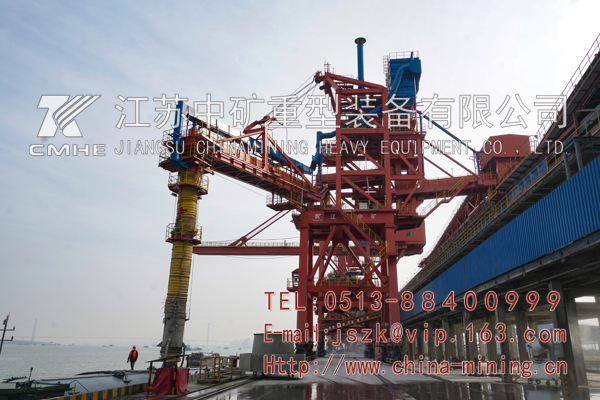
A linear rail ship loader is a highly efficient bulk material handling system widely used in ports, terminals, and large bulk storage yards. Operators use this equipment to transfer bulk materials—such as coal, ore, and grain—directly from stockpiles or conveyor systems into the cargo holds of ships berthed at the quay.
Unlike conventional loading systems, a linear rail ship loader travels along a fixed straight track. It uses a telescopic boom or conveyor structure to deliver materials accurately and continuously. As a result, it achieves high operational efficiency, strong adaptability, and a high level of automation. For this reason, modern bulk terminals consider it an essential piece of equipment.
Key Features of Linear Rail Ship Loaders
High Transport Efficiency
First, linear rail ship loaders move materials quickly and accurately from land-based systems to vessels. This direct transfer significantly improves overall logistics efficiency and reduces handling time.
High Operational Productivity
In addition, the system adopts a continuous conveying method, typically combining a belt conveyor with a telescopic chute. Operators can also adjust the conveying speed—usually ranging from 300 to 1000 tons per hour. Consequently, the system greatly shortens the loading time for each vessel.
Precise Positioning and Stability
Moreover, the equipment runs along a predefined straight track, which ensures consistent movement. By using servo motors or hydraulic drive systems, operators achieve millimeter-level positioning accuracy. This precision allows materials to fall exactly into designated cargo holds.
At the same time, the rail-guided design minimizes vibration and swaying. Therefore, the system maintains excellent stability, even in ports with strong winds and waves.
Adaptability to Various Materials and Vessel Types
Furthermore, operators can easily adjust the system to handle different bulk materials and ship configurations. For example, they can modify the telescopic chute length (typically ranging from 5 to 40 meters), adjust the conveyor belt angle (from 0° to 45°), and install material distribution devices. As a result, the system can handle coal, iron ore, cement clinker, and other materials with varying densities and particle sizes.
Automation and Intelligent Control
Modern linear rail ship loaders also integrate advanced automation technologies. For instance, engineers equip them with PLC control systems, laser ranging sensors, and ship profile recognition systems. These technologies enable automatic hatch alignment, automatic speed adjustment, and obstacle avoidance. Consequently, the system reduces manual intervention and enhances operational safety.
Enhanced Safety in Operations
Finally, automation significantly reduces the need for manual work at height, lowering safety risks for operators. At the same time, the system ensures stable and controlled material transfer, which minimizes cargo loss during loading.
Conclusion
In summary, the linear rail ship loader plays a critical role in bulk cargo terminals. Its large-span traveling structure eliminates the tipping risks associated with long cantilever designs, making it especially suitable for vessels with long or wide cargo holds.
To maintain optimal performance, operators should carry out regular inspection and maintenance. With proper care, the system delivers reliable, efficient, and safe loading operations over the long term.